Absorbers#
Plain#
A discussion of the properties of plain absorptive materials is available here.
Slatted#
A common method of architecturally protecting sound absorbing materials is to cover them with slats (strips of timber for instance).
The effect of this is to produce a mildly tuned resonator which slightly enhances low frequency absorption, causes a peak in the absorption around the resonant frequency and significantly reduces the absorption above the resonant frequency. The width and thickness of the slats and the spacing between slats are entered in the appropriate boxes.
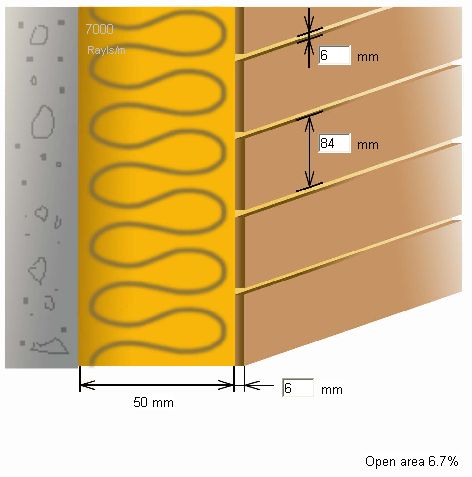
Verification
Zorba has been verified with absorption thicknesses from about 20 mm to 100 mm and with slats of 20 mm to 150 mm wide with spacings from 3 mm to 75 mm. Do not use outside this range without verifying with measurement data.
Perforated#
Another common method of architecturally protecting sound absorbing materials is to cover them with a panel material (eg plywood) that has a series of holes or perforations to allow the sound waves to penetrate into the absorbing material.
The effect of this is to produce a mildly tuned resonator which slightly enhances low frequency absorption, causes a peak in the absorption around the resonant frequency and significantly reduces the absorption above the resonant frequency. The thickness of the panel and the diameter and spacing between holes are entered in the appropriate boxes.
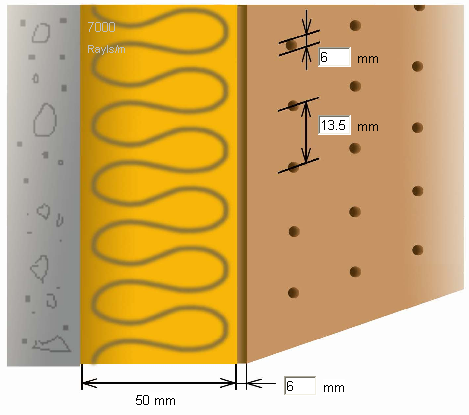
Verification
Zorba has been verified with absorption thicknesses from about 20 mm to 100 mm, with hole spacings from 10 mm to 100 mm and hole diameters from 3 mm to 12 mm. Do not use outside this range without verifying with measurement data.
Slotted#
Similar to perforated absorbers as series of slots allow the sound waves to penetrate into the absorbing material.
The thickness of the panel and the diameter and spacing between holes are entered in the appropriate boxes.
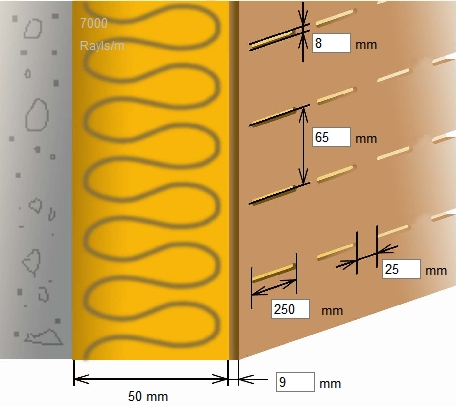
Verification
Zorba has been verified with absorption thicknesses from about 20 mm to 100 mm, with hole spacings from 10 mm to 100 mm and hole diameters from 3 mm to 12 mm. Do not use outside this range without verifying with measurement data.
Panel#
A panel absorber is formed by an impervious material such as plywood or gypsum plasterboard fixed over an airgap. There can sometimes be an acoustic blanket in the airgap.
Panel absorption is often an unintended byproduct of a wall or ceiling construction and is mostly a low frequency phenomenon. Typical panel absorbers are plasterboard on timber studs, or plywood or timber panelling over a masonry wall.
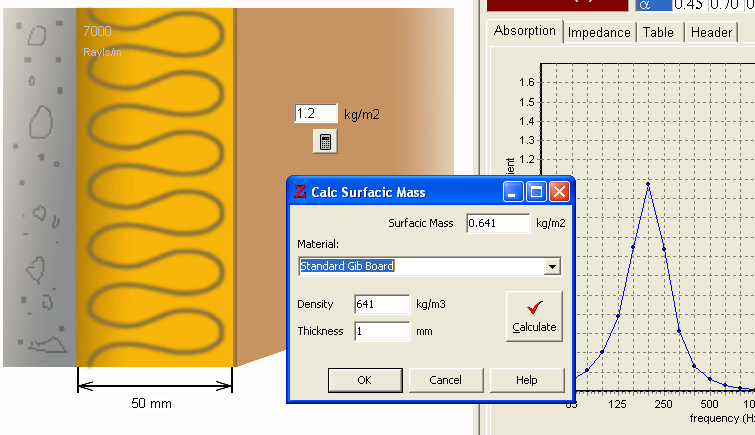
Zorba will model with reasonable accuracy panels as light as 0.1 kg/m2 up to panels of 20 kg/m2. There is a built in calculator for estimating the panel mass for different materials and thicknesses.