Acoustic Impedance#
The acoustic impedance is usually defined at the front surface of a material and is the sound pressure divided by the acoustic particle velocity at that point. It is usually a complex quantity and is almost always frequency dependant. The values of acoustic impedance can be used to provide an understanding of the behaviour of the material and hence ways in which the absorption can be improved. Note that for a plane wave at normal incidence an absorption coefficient of 1 is only obtained for a material whose acoustic impedance has a real part equal to the characteristic impedance of air ( = 410 Rayls) and an imaginary part equal to zero.
It is often convenient to divide acoustic impedances by the characteristic impedance of air to get a dimensionless quantity called the specific acoustic impedance. An absorption coefficient of 1 is then obtained for a specific acoustic impedance of (1,0).
Some insight into the absorber can be gained from a plot of real and imaginary parts of the acoustic impedance at different frequencies (this is sometimes called a Smiths Chart). For plain porous absorbers the plot will be a spiral starting at the bottom left of the complex plane and spiralling into the point (1,0). To see this behaviour choose a thick material (say 100 mm) of relatively low flow resistivity (say 1500 Rayls/m) and then click on the calculate button then on the impedance tab. The plot will show a typical impedance spiral. Note that with increasing frequency this spirals into a specific impedance value of (1,0) which will give an absorption coefficient of 1.
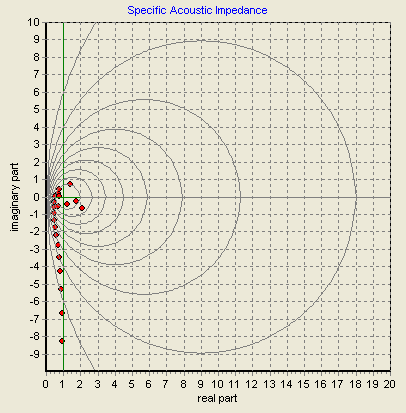
Some quick points to help with interpreting the impedance plot:
- A depth of air or porous material which is less than 1/4 of a wavelength deep will exhibit a negative imaginary impedance.
- A solid surface such as a layer of plywood over an air cavity will exhibit a positive imaginary impedance.
- For a resonant system at the resonant frequency the imaginary part of the impedance equals zero.
- Increasing the flow resistivity of a material will usually increase the real part of the acoustic impedance.