Limitations#
Users should be aware of the limitations, like any prediction tool Zorba is not a substitute for test data. Measurements of the random incidence coefficiences are carried out in standardised test rooms with standardised configurations of materials, but even so the spread of results between laboratories is rather large. In a series of round robin experiments a sample of 50mm thick rockwool was measured in 21 different laboratories in Australia and New Zealand. The difference between laboratories was large, and even when only those six rooms which conformed to the ISO test standard were included the agreement was still not exact. Remember this is for the same sample, measured with the same equipment. So it can be seen that we can not hope to achieve "exact" agreement between theory and a single set of measurements.
An indication of inter-laboratory variability can be seen from the graph below from ISO 354-1985.
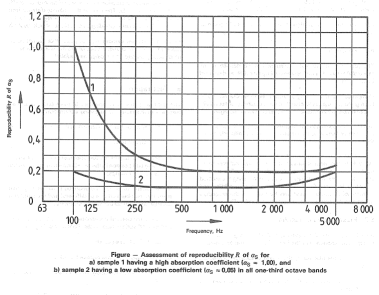
Note that in general the model gives reasonable agreement for perforation ratios as low as 5% and porous absorption thicknesses between 10mm and 150mm. It should be used with caution outside these limits. It can not be used for absorbers with a significant air cavity as these arrangements are not locally reacting. It can not be used with porous materials which have a porosity less than about 80% or a flow resistivity of more than 100,000 Rayls/m or less than 1,000 Rayls/m.